
Betazon
Clickriver – eine Art Shopsense von Amazon (via)
((irgendwie knabbert Amazon am Quasimonopol von Google als fordistischer Beta-Produzent; während Google im gesamten Oktober nur 6 Betas veröffentlichte, ist das für Amazon nach askville und nownow schon das dritte innerhalb einer Woche))
Lib
Y Combinator hat eine Leseliste für (ihre) Startups: Startup Library
Weglassen
Eine reduktionistische, aber absolut gelungene Woot!-Variante für Kunstfreunde
netselektr

Tatsächlich mit einem Hauch Innovation präsentiert sich das heute an den Start gegangene netselektor – eine Art sozialer Bookmarksmanager mit redaktionellem Zuckerguss (Organisation in Rubriken, Screenshot und kleine Aufsätze zu den empfohlenen Links) in hübschem Design.
Aus der Selbstbeschreibung (die gleich mal in einem autoreflexiven Modus als Seite des Tages ausgewählt wurde):
Netselektor filtert. Und trennt. Und pickt. Das neue Webmagazin Netselektor basiert auf der revolutionären Idee des Web 2.0, des „jeder kann mitmachen“, kombiniert diesen Gedanken jedoch mit klassischer redaktioneller Arbeit.
… Der Nutzer erkennt auf einen Blick, ob die Website von der Redaktion empfohlen wurde oder nicht: die grauen Einträge stammen von den Usern, die grünen Einträge sind die positiv von der Redaktion bewerteten „Webtipps“. Damit haben die Besucher einerseits die Möglichkeit, aus einer Vielzahl von Angeboten zu wählen, andererseits aber die Gewissheit, im grünen Bereich ausnahmslos vertrauenswürdige Informationen vorzufinden.
BBAuth
Der hier vor kurzem erwähnte Anmeldemechanismus von Menuism basiert übrigens auf Yahoo’s BBAuth und kommt gut an:
And we’re happy to say that since we implemented it on Oct 20th, we’ve had almost 70% of new users use the Yahoo Sign In approach. I hope that means people are finding it easy and useful.
… Yahoo has more than 250 million users (from what I last saw) which means there’s quite a few people who are eligible to signup.
Blah
aus dem Techcrunch-Thread des vorigen Eintrags:
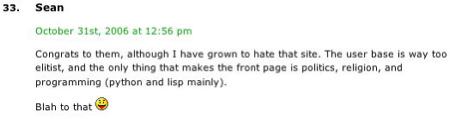
…

(abt. für die leicht zu unterhaltenden)
Shopping Pt. 5
und Wired / Conde Nast übernimmt Reddit
Shopping Pt. 4
Google bleibt ein gefrässiger Pacman und übernimmt JotSpot
Sweatsourcing
Planblog zu Crowdsourcing zwischen Sweatshops und politischem Engagement bzw. Potential: Opportunities for politics and government
The 7 Habits of Highly Effective Web 2.0 Sites
von Dion Hinchcliffe (dem Begründer der Web 2.0 Diagrammkunst):
- Ease of Use is the most important feature of any Web site, Web application, or program.
- Open up your data as much possible. There is no future in hoarding data, only controlling it.
- Aggressively add feedback loops to everything. Pull out the loops that don’t seem to matter and emphasize the ones that give results.
- Continuous release cycles. The bigger the release, the more unwieldy it becomes (more dependencies, more planning, more disruption.) Organic growth is the most powerful, adaptive, and resilient.
- Make your users part of your software. They are your most valuable source of content, feedback, and passion. Start understanding social architecture. Give up non-essential control. Or your users will likely go elsewhere.
- Turn your applications into platforms. An application usually has a single predetermined use, a platform is design to be the foundation of something bigger. Instead of getting a single type of use from your software and data, you might be hundreds or thousands of them.
- Don’t create social communities just to have them. They aren’t a checklist item. But do empower inspired users to create them.
Hype oder Wertschöpfungsfaktor?
4 Präsentationen von einem T-Systems Multimedia Frühstück.
Und einmal mehr bin ich froh
A collection of six word epics
Last Exit
The Obvious Corp – Evan and Biz take back Odeo
Das Exit-Modell
Every venture funded tech company is predicated on the idea of ‘exit’, the point where the company is sold to a bigger one or has an IPO, so that the investors see a return and move on.
This time round, in the 2.0 boom, there are almost no IPOs, and the exceptions, like Vonage, have been a disaster.
That leaves the second option, selling the company to a bigger one. Unlike during the dotcom boom, the big galaxies, Google, Yahoo, Ebay etc. are properly formed, and surely ready to suck in more stars.
… In addition, these are all-or-nothing plays. In a parallel universe, all three companies could have folded, leaving them in the same position as their numerous competitors. Their success was not planned and was very high risk. They are species that survived in a particular evolutionary niche that opened up, they were not ‘intelligently designed’.
Das tragfähige Modell
The alternative is to question the whole notion of exit and to build a real company.
(via)
((abt. hackr startup school VI))
I feel like blogging
Did you say blogging? (philtube)
(thx. real Phil)
Plastilin

Web 2.0 ist ein plastischer Begriff. Die Bedeutung ist nicht festgelegt oder fixiert, sondern muss gewissermassen von jedem für sich selbst erarbeitet werden. Es gibt keine ultimative Referenz oder Definition. Die Aussagekraft des Begriffes hängt deshalb also von der Arbeit ab, die man selbst hineinsteckt. Wer es sich leicht macht (wie etwa ein Großteil der Massenmedien, wo ein Journalist mal schnell irgendwas zusammengesampelt hat und die anderen die immer gleichen Ressentiments, Vorurteile und 5 Paradebeispiele von Firmen dann abgeschrieben und weitergetragen haben), der agiert dann mit einem einfachen, aber eben auch undifferenzierten Begriff, der dann halt tatsächlich auch wenig bzw. nichts bringt.
Das bedeutet nicht, dass man Web 2.0 beliebig definieren kann – zumindest wenn man mit anderen kommunizieren will. Web 2.0 entsteht sicherlich irgendwo als Beschreibung der Ensembles von neuen Möglichkeiten, die die zunehmende Ausdifferenzierung der beteiligten Systeme (Mensch und Maschine, Soziologie und Ökonomie, …) und deren Zusammenspiel, zunehmende Interpenetration und Koppelungen, etc. ermöglichen. Je nach Interesse machen dabei unterschiedliche Beobachtungspostionen Sinn, man sollte aber im Hinterkopf behalten, dass es immer auch andere gibt. Wer Tomaten auf den Augen hat und glaubt, da sei überhaupt nichts ausser einem Buzzword oder Hype, dem kann man auch nicht helfen.
(abt. nur mal so)
Interestingness und Metadatenranking
Yahoo will patentieren lassen:
Media objects, such as images or soundtracks, may be ranked according to a new class of metrics known as “interestingness.” These rankings may be based at least in part on the quantity of user-entered metadata concerning the media object, the number of users who have assigned metadata to the media object, access patterns related to the media object, and/or a lapse of time related to the media object.
Media object metadata association and ranking
Metadata may be associated with media objects by providing media objects for display, and accepting input concerning the media objects, where the input may include at least two different types of metadata. For example, metadata may be in the form of tags, comments, annotations or favorites. The media objects may be searched according to metadata, and ranked in a variety of ways.
Textile 2.0
… ist da – mit einigen nützlichen Verbesserungen.
(Textile ist ein Web Text Generator, d.h. man schreibt Text in einer einfachen Auszeichnungssyntax und das wird dann von der jeweiligen Anwendung in HTML transformiert; sehr zeitsparend)
Freelancing
A beginner’s guide to freelancing
((abt. hackr startup school V))
Getting Real
37signals Getting Real, the Book – das kommunistische Manifest der Rails-Generation – ist jetzt (nebst PDF und Lulu-Taschenbuch) auch online und gratis verfügbar.
((abt. hackr startup school IV))
In 80 Tagen in die Welt
Experiment des Center for Digital Technology and Management (TU und Ludwig Max Uni München):
Innerhalb von fünf Tagen und Nächten haben wir – eine Gruppe von 16 Studenten, Mitarbeitern und Alumnis – die buchpfade-Plattform [war http://www.buchpfade.de/] entwickelt und bis zu einer launchfähigen Version realisiert.
… wir [wollten] herausfinden, wie schnell sich eine typische Web 2.0 Plattform entwickeln lässt.
Exciting Commerce rechnet vor:
Interessant dabei: Für Buchpfade brauchten 16 Mann je 5 Tage bis zum Launch; für Sozeug.net ein Mann ca. 80 Tage. 80 bis 90 Manntage scheint eine gute Orientierungsgröße für (einfache) Web 2.0 Plattformen zu sein.
Eine API oder Feeds gibt’s noch nicht (wenn man die Web 2.0 Standardfeatures als Referenz nehmen wollte), dafür aber eine nette Buchlebens-Timeline, das Ergebnis lässt sich jedenfalls durchaus sehen.
((abt. hackr startup school III))