
Underground Resistance
Underground bei YouTube (via mashable)
Myswitchboard
myswitchboard – eine Art Ahne von Startseiten wie netvibes, pageflakes, etc.
(file under: später mal ausprobieren)
Runtime Error
abt. post viral life-back-hacks
abt. incentivize data-driven ereignishorizonte
abt. iCandy r&r mashups
abt. create user-centred look-a-likes
abt. modificate semantic value
abt. disintermediate wurstsalat synergies
abt. remix mem-o-mat-capable value
abt. ersatz rtzl
Kommunismus zum Downloaden
erinnert die RIAA – siehe die Illustration bei Techcrunch
Cereal Killer
und Richard MacManus startet eine neue Serie: Interviews mit VCs (via)
Elektrischer Reiter
neues wöchentliches Vlog von Mario Sixtus und dem Handelsblatt: Elektrischer Reporter (via)
Komisch
Geert Lovink zum Web 2.0
((anachronistischer Text; Lovink war ja einer der Hauptdenker der Netzkunst/-kritik/-politik… Diskurse in den 90ern, wo ziemlich viel Text/Theorie produziert wurde – während das Web 2.0 bisher mehr oder weniger völlig ohne Theorie auskommt; sein geschulter Blick bringt aber irgendwie nichts))
delicious 101
sehr supere grundsätzliche Einführung in del.icio.us
(via agenturblog)
Wienerschnitzel
2 wöchige (oder so) Pause, hier.
Archivism
(shocking, keine beta)
New Wave
Globalization creates wealth at the price of the social, the cultural, and the human. 2.0 creates wealth by amplifying the social, the cultural, and the human. For the next wave of entrepreneurs, this will be the market gap where profits are to be discovered.
DIY Reader
Holy guacamole – Jack Slocum zeigt wie man sich mit ein paar Zeilen JavaScript und der Yahoo! UI Bibliothek und deren neuen Grid Komponente einen Feedreader bauen kann.
(via planet ajaxian)
Kapitalismus und Schizophrenie II
Nicht nur Michael Arrington expandiert (CrunchBoard, CrunchGear, TechCrunch UK – TechCrunch DE und MX, CuteCrunchPets, CrunchHacker, CrunchingCrunching sind nur eine Frage der Zeit), auch Om Malik (GigaOM Jobs, GigaOM Polls) baut aus: Web Worker Daily – das Blog für die neue (sich selbst deterritorialisierende und im Web reterritorialisierende) Arbeiterklasse.
Gedächtnis und Leidenschaft
Podcast mit Joshua Schachter bei Web 2.0 Voices
hörenswert, u.a. zum Übergang vom Einzel- zum Gruppengedächtnis
del.icio.us is all about memory and how we save and remember and share things.
… building a powerful single person memory (you can keep the things you’ve found found) going to a way to have a shared memory system (you can save things and other people can recall them)
und zur Leidenschaft als Motor des Web 2.0
Web 2.0 is about rapidly decreasing costs in terms of time and man power, developing applications and getting them outside to the real world
… people who are passionate about a topic or subject are able to produce an application relevant to that subject with much less effort and much less hardware than previous.
… a passion for the subject at hand, which makes for a much more vibrant and interesting communities and products that go with that passions.
(via folgendesdaseins [war: http://www.folgendesdasein.de/wordpress/?p=98])
Writely Olive
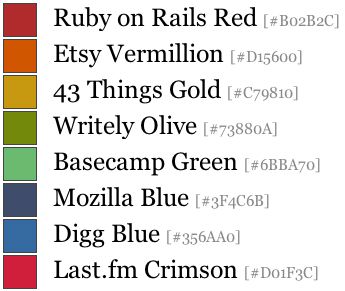
mehr bei der Web 2.0 Farbpalette
Hermeneutik
(abt. postbubble)
TechCrunch’s Marshall Kirkpatrick interviewt Paul Graham
(subabt. organic capital)
There’s definitely a trend toward smaller investments, because it costs so much less to start a startup now. And if you take less money initially, you keep more options open…
It may not be a coincidence that both Flickr and Del.icio.us avoided the usual VC route. Both had to get a lot of subtle, social things just right. You’re more likely to do that if you can evolve organically….
And yet reddit is not only able to compete [against digg], but has a visibly more authentic, participatory feeling. I read that the top 100 Digg users submit 56% of the frontpage stories. The frontpage stories on reddit are much more widely distributed. And that may be because reddit grew organically, through word of mouth, like Flickr and Del.icio.us did.
(subabt. wo ist das geschäftsmodell)
What I tell founders is not to sweat the business model too much at first. The most important task at first is to built something people want. If you don’t do that, it won’t matter how clever your business model is.
Of course you have to have a business model eventually. But experience so far suggests that figuring out how to make money from something popular is a lot easier than making something popular.
(subabt. bubble)
Is this another Bubble? I don’t think so, not so far. There may be a lot of lame startups being started, but that’s not the definition of a bubble. A bubble is when a lot of money is being invested in lame startups, and that’s not happening yet. The reason so many new startups are getting started is that the cost has gone down, not that funding has gone up.
(subabt. disruptive)
Frankly, even though I’m supposed to be an investor, the ideas that excite me most are not necessarily the ones that make the most money, but the ones that blow away evil old monopolies. For example, I love collaborative news sites not so much because they make a lot of money– though they might – but because they’ve shown what a bad job the “old media” were doing.
Most people don’t understand what a social force startups can be. There are a lot of changes that can only happen through companies. One startup I dream of funding is the one that kills the record companies. You know your business model is broken when you’re suing your customers. The new business model must be out there somewhere, and my guess is that the way to beat the bad guys is not through political action (or at least, not only that), but by inventing whatever replaces them.
(subabt. goooogle)
I wouldn’t advise competing with Google in things they’re good at. So what is Google good at? As a first approximation, making things their own developers use at work.
(subabt. 2.0)
To me “web 2.0″ translates to “web.”
Crowdtagging
Tagging ist zwar üblicherweise ohnehin crowdsourcend, aber eine konzertierte Aktion ist zumindest für Google neu:
Google Image Labeler soll die Qualität der Bildsuche erhöhen, indem spielerisch Labels (Googlespeak für Tags) vergeben werden:
You’ll be randomly paired with a partner who’s online and using the feature. Over a 90-second period, you and your partner will be shown the same set of images and asked to provide as many labels as possible to describe each image you see. When your label matches your partner’s label, you’ll earn some points and move on to the next image until time runs out. After time expires, you can explore the images you’ve seen and the websites where those images were found. And we’ll show you the points you’ve earned throughout the session.
(ist nicht uninteressant, weil Google bisher ja fast schon paranoid vor menschlichem Zutun zurückgeschreckt ist; what’s next?)
TrackMeNot
TrackMeNot – Firefox Extension, die Suchmaschinen das Erstellen von Profilen erschwert, indem im Hintergrund periodisch per Zufallsgenerator erzeugte Suchen abgefragt werden.
Nuss
Quiz: Was ist Web 2.0?
- oder besser gefragt: welche (terminologischen, konzeptionellen, …) Unterscheidungen bringen uns weiter?
(Auflösung am 1.9.2016)
Mini-Me
Exciting Commerce zum erneuerten jedem sein eigener Shop Zlio und zum jedem sein eigenes Jobboard Jobthread
(bei dem mir die Preisgestaltung für die Groups etwas happig vorkommt; 50% der Einnahmen gehen dabei an JobThread, zum Antesten ist das ev. in Ordnung, aber ab dem 20, 30 Posting hätte sich eine selbstgestrickte Lösung wohl amortisiert)