 abt. quoted
Zeitgeist oder Enzyklopädie
Der Punkt ist wahrscheinlich, dass die Wikipedia sich einfach entscheiden muss, was sie darstellen will: Ein Arsenal des volkstümlichen Meinens und der Zeitgeistigkeiten (was ja, vom mentalitätsgeschichtlichen Standpunkt aus betrachtet, keine schlechte Sache wäre): Dann wird sie ihre Offenheit beibehalten, aber logischerweise auch nie an ein Ende kommen können. Oder ein echtes Pendant zu akademischen Enzyklopädien: Selbst bei einer Abgrenzung von den akademischen Diskussionen wird man dann wohl nicht darum herumkommen, Verantwortlichkeiten zu definieren.
Überwachen und Strafen
man könnte sagen, dass all das, was zur Zeit so unter dem Etikett Web 2.0 verkauft wird, im Spannungsfeld zwischen diesen beiden Polen [Objekt einer Information / Subjekt in einer Kommunikation] Platz hat. Denn einerseits gibt es da viele Applikationen, Konzepte und Ideen, die eine Art Graswurzel-Charme ins Internet zurückführen: Blogs, Foto-Communities, soziale Netzwerke bieten durchaus die Chance, aus passiven Konsumenten kommunizierende Subjekte zu machen und neue Diskussionen zu führen. Der Preis dafür ist aber eine größere Sichtbarkeit, denn die Medien, die die Kommunikation ermöglichen, sind so verräterisch wie das Sonnenlicht, das die Zellen in Benthams Panopticon ausleuchtet. Und anders als das Sonnenlicht können sie das, was sie an den Tag bringen, auch noch aufzeichnen, und weil sie das mit einem stumpfen und rein quantifizierenden Gleichmut tun, wie ein Zellenwärter, der die Bewegungen eines Sträflings auf seiner Strichliste abhakt, sind sie umso bedrohlicher.
Terminologie
Ich wünsche mir wirklich, jeder, der in den Schwachsinnskanon gegen das Web 2.0 einstimmt, würde das hier lesen.
Where this whole thing gets interesting is that many of the Web 2.0 buzzwords actually DO—for some people—compress and convey rich information. In other words, while I make a distinction between empty buzzwords and domain-specific terms, sometimes there’s no clear line between the two. One guy’s Web 2.0 empty buzzword is another one’s meaningful addition to the emerging technology lexicon.
And that brings up the other thing I like about Web 2.0—that it has engaged so many people’s minds in actively creating/defining/interpreting the meaning of the ideas, words, and concepts. Web 2.0 is both ambiguous and meaningful… but not for everyone. For many, the words are just useless marketing speak with no there there.
My problem with the Web 2.0 terms is not that they are meaningless. And my problem is not that they are too complex and should be dumbed down. My problem is that they are focused on the technology and the business model, rather than focusing on what those things will mean to the end-user. And when I say “mean to the end-user”, I don’t mean that the end-user cares about the words. The end-user cares about what WE—the developers/implementors of Web 2.0-ish products or services—are creating for them.
When I say that the Web 2.0 words aren’t user-driven, I don’t mean that the users should be driving or even understanding the words. But if a deep concern for users isn’t driving the meaning of these words, we’re in for a flock of crap products and services that implement 2.0 goodness but do nothing to inspire or engage users. Again, my problem with 2.0 words is not about what they mean, or how consice or confusing they are, as much as about what they’re focused on.
Slashdot
Dion Hinchcliffe: Five Reasons Why Web 2.0 Matters
engage ourselves … participate and collaborate together … mutually trust and enrich each other … critical mass and synergy … harnessing collective intelligence … radical decentralization … core set of Web 2.0 techniques … value curve goes geometric … ROI … Ballistic Trajectory … leviathan forces of attention and enthusiasm … ride the wave.
und Slashdot murmelt dazu
Der User und der Buzz
Kathy Sierra (wie eigentlich immer) sehr charmant zur Halbwertszeit von buzzwords und welche Perspektive man zumindest mitdenken sollte
But these Web 2.x buzzwords are more technology and business-model focused than user focused, and that’s a recipe for building things that meet the checklist but fail the users.
For example, we know that “harnessing collective intelligence” is good… but why? I don’t necessarily want you “harnessing” my anything, unless… unless it means I benefit from the result. And of course, that’s the point— that end-users can benefit from all that group wisdom, like Amazon reviews or delicious/popular tags, to help reduce the flood of data. So why not say it like that? Instead of calling it “harnessing collective intelligence”, why not call it “helping users make smarter choices, more quickly, by accessing the knowledge, experience, and wisdom of a larger group?”
Das 2 im Web 2.0?
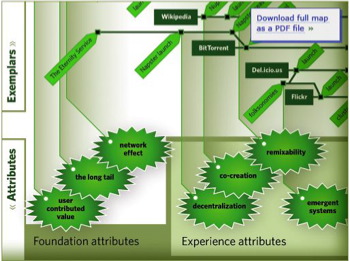
Wieder einmal eine schöne neue Map des Web 2.0, von Adaptive Path: Experience Attributes: Crucial DNA of Web 2.0.
Wenn man mitdenkt, dass Adaptive Path User-Experience Expertise verkauft, ist der Artikel auch ganz wunderbar:
Some of the attributes we associate with Web 2.0 were introduced and commercialized as early as the mid 1990s; let’s call these Foundation Attributes. The figure detail below is part of a PDF that separates these “significant but not sufficient” attributes from the more recent Experience Attributes, those that create the kind of value that’s caused the recent excitement over Web 2.0.
Foundation Attributes:
User-Contributed Value – Users make substantive contributions to enhance the overall value of a service.
The Long Tail – Beating the sales of one or two best-seller products by using the Internet to sell a cumulatively greater amount of the products that have low demand or low sales.
Network Effect – For users, the value of the network substantially increases with the addition of each new user.
Experience Attributes:
Decentralization – Users experience services on their terms, not those of a centralized authority, such as a corporation.
Co-creation – Users participate in the creation and delivery of the primary value of a service.
Remixability – Experiences are created and tailored to user needs by integrating the capabilities of multiple services and organizations.
Emergent Systems – Cumulative actions at the lowest levels of the system drive the form and value of the overall system. Users derive value not only from the service itself, but also the overall shape that a service inherits from user behaviors.
für die nächste Pressemitteilung:
When Experience Attributes are combined with Foundation Attributes for a Web 2.0 offering, the result can be a valuable new service with a fast-growth business model.
… By blurring the lines that traditionally delineate supplier, vendor, and customer, these services have pioneered new value streams that can output new types of offerings, harness new efficiencies, and produce higher levels of continuous innovation. Experience Attributes make Web 2.0 offerings fierce competitors in their respective marketplaces.
… Building on one of the Experience Attributes will give you a competitive advantage and a differentiating new value for your Web 2.0 offering. Experience Attributes should provide you with a value stream and a service offering that looks, works, and feels much different from that of your marketplace competitors.
Auch gut
Well, it is true that these applications do Less of stuff we don’t want, an undeniably good thing. But it isn’t true that they do Less of everything. In fact, they do More of a critical function of Web 2.0 applications. What is it that they do that’s so critical?
They’re networked. And being networked allows them them to accurately model our social behavior, of course! Almost overnight, we are using these software applications to better fulfill our basic human needs of communication, gossip, collaboration, sharing, and Attention. All things we do in our human network. Now we’re doing it in networked software.
The big shift in Web 2.0 is not that we want Less, despite some of the horribly bloated desktop applications we’ve had to put up with. In fact, we want More, and we’re getting it!
In essence, we have traded siloed applications for networked ones. We’ve migrated away from the featuritis of desktop applications to socially-enabled networked ones. The featuritis was a beneficial casualty of the move. So it’s not just about Less features. It’s about Social features.
Soziale Netzwerke und Aufmerksamkeitsnetzwerke
Attention Networks vs. Social Networks
Part of the problem is that we’ve built a model off of social networks instead of attention networks and there’s a very subtle difference between the two. Attention networks recognize power. They recognize that someone may actually have a good collection of references or be a good photographer and that someone else may want to pay attention to them even if their own collections are not worthy of reciprocation. Attention networks realize that the world is not an undirected graph.
Der Finger auf der Wunde
Don Alphonso in einem Kommentar zu einem Eintrag (so lala Interview zu Flock) im Spreeblick:
Der Grundfehler ist, dass die Avantgarde der Technik ihren Status als neue Kultur definiert und ganz selbstverständlich davon ausgeht, dass der Rest mitzieht, weil es halt besser, sozialer, 2.0iger, kulturiger ist. Dummerweise lese ich bei dieser Avantgarde NIE etwas Fundierts über Kulturphänomene oder verifizierbare gesellschaftliche Prozesse, nie über wirtschaftliche Zusammenhänge, sondern immer nur Technik. Dem grossen Rest, der die Kultur noch nicht mal kennt, das hat man übrigens bei beiden Debatten gesehen, geht das Ganze völlig am Arsch vorbei. Der mich nun besonders umtreibende wirtschaftliche Aspekt ist gewissermassen die für web2.0 letztlich entscheidende Schnittstelle zwischen Technik und Kultur im Sinne eines Proof of Concept; wenn es die angenommene Kultur gäbe, müsste es auch wirtschaftlich gut laufen. Es müsste einen Markt geben, am besten ohne Drecksmethoden wie Datamining und Profiling. Wenn der Markt allerdings mit bereits morschen Konzepten einerseits und Phrasen andererseits beliefert wird, ist das nicht wirklich eine gute Basis für eine Kultur, sondern allenfalls für das, was in solchen Fällen eben entsteht: Die sich am Widerspruch zwischen Akzeptanz und Möglichkeit, zwischen realer und geplanter Kultur aufblähende Bubble – was dann tatsächlich eine Kultur beinhaltet, aber nicht das, was man gerne hätte.
dendritisches Netzwerk
Siggi Becker zu Google Analytics
Die Domains die von GA getrackt werden, verschmelzen mit einem Schlag zu einer einzigen, gigantischen Harddisk. Die Daten die dadurch entstehen, kann man sich durch ein riesiges, dendritisches Netzwerk visualisiert vorstellen, das je nach Tageszeit sektorielle Fluten aufweist. Hinter je einem Huflein von kleinen Knoten sitzt ein biologisches Gehirn. Wir sind das Interface. Alles hat sich mit einem Schlag verkehrt. Was sagen die Schwellungen der dendritischen Röhrchen über die Relevanz der Knötchen aus? Wo sitzt die Intelligenz? Im Zwischen oder im über?
Das Kontinuum der Web 2.0 Erfahrung
Auch lesenswert: The Web 2.0 Experience Continuum bei adaptive path.
On the conservative side of this experience continuum, we’ll still have familiar Websites, like blogs, homepages, marketing and communication sites, the big content providers (in one form or another), search engines, and so on. These are structured experiences. Their form and content are determined mainly by their designers and creators.
In the middle of the continuum, we’ll have rich, desktop-like applications that have migrated to the Web, thanks to Ajax, Flex, Flash, Laszlo, and whatever else comes along. These will be traditional desktop applications like word processing, spreadsheets, and email. But the more interesting will be Internet-native, those built to take advantage of the strengths of the Internet: collective actions and data (e.g. Amazon’s “People who bought this also bought…”), social communities across wide distances (Yahoo Groups), aggregation of many sources of data, near real-time access to timely data (stock quotes, news), and easy publishing of content from one to many (blogs, Flickr).
The experiences here in the middle of the continuum are semi-structured in that they specify the types of experiences you can have with them, but users supply the content (such as it is).
On the far side of the continuum are the unstructured experiences: a glut of new services, many of which won’t have Websites to visit at all. We’ll see loose collections of application parts, content, and data that don’t exist anywhere really, yet can be located, used, reused, fixed, and remixed.
The content you’ll search for and use might reside on an individual computer, a mobile phone, even traffic sensors along a remote highway. But you probably won’t need to know where these loose bits live; your tools will know.
These unstructured bits won’t be useful without the tools and the knowledge necessary to make sense of them, sort of how an HTML file doesn’t make much sense without a browser to view it. Indeed, many of them will be inaccessible or hidden if you don’t have the right tools.
Offenheit
Das schöne an Jeff Jarvis: er kennt sich zwar technisch nicht wirklich aus (wage ich einmal zu behaupten, dafür liegt er mit manchen Statements zu krass daneben, sag ich jetzt mal so), aber er hat sehr oft einen guten Blick auf die Technologien, etwa in Google Base v. microformats:
What we need instead is a means of letting you tag and structure your data so it can be found reliably by any search engine no matter where it is on the internet. That would stay true to the distributed internet Google has so masterfully exploited.
I wish I were hearing more noise from the microformats guys to act as competitors — or at least as pressure on Google for openness and standards.
… And imagine if you could go to Google or other services — e.g., Indeed and SimplyHired for jobs or Baristanet for three Jersey towns — and see the tags they use so you can swarm around those tags and find and be found. That’s the openness we need. If Google spearheads that with a truly open API that can be adapted by the community, then great. That is our distributed marketplace. But if not, then Google is only trying to recreate the centralized marketplaces of old — otherwise known as newspapers. That worked for newspapers when they had monopolies. They don’t anymore. Does Google think it has a monopoly?
update 21.11: siehe auch das
Paul Graham zum Web 2.0
Der – aus meiner Sicht – wichtigste Artikel zum Web 2.0 seit langem: Paul Graham’s Web 2.0.
Wichtig nicht, weil drin was neues steht, sondern weil er aus einer ungehypten Perspektive die Kernpunkte kristallisiert:
Web 2.0 ist nicht ein 2.0 von irgendwas, sondern ein Web, das etwas anders, besser funktioniert, in dem vieles möglich geworden ist.
(dieses 2.0 ist – zumindest in Deutschland – eine endlose Quelle für völlig unnötige Diskussionen, unwitzige Witzchen und dümmliche Trotzhaltungen)
Web 2.0 ist demokratisch
amateurs can surpass professionals, when they have the right kind of system to channel their efforts. Wikipedia may be the most famous. Experts have given Wikipedia middling reviews, but they miss the critical point: it’s good enough. And it’s free, which means people actually read it. On the web, articles you have to pay for might as well not exist. Even if you were willing to pay to read them yourself, you can’t link to them. They’re not part of the conversation.
Web 2.0 nimmt die Menschen ernst
I think the root of the problem was that sites felt they were giving something away for free, and till recently a company giving anything away for free could be pretty high-handed about it. Sometimes it reached the point of economic sadism: site owners assumed that the more pain they caused the user, the more benefit it must be to them.
Hmm, schlecht zitiert, selber lesen.
Und wer noch nicht mehr als
20 Artikel zu Sony’s rootkit gelesen hat, der könnte sich diesen Artikel in Wired anschauen;
Gesehen bei wirres in einem durchaus lesenswerten Posting, falls man noch keine Antikörper gegen den Komplex Blogs vs. Journalismus ausgebildet hat.
ich bin ja teilweise auch der meinung, dass die verlage vor allem einen verkaufsfehler machen. es geht nicht darum (jetzt auch noch) zu bloggen, sondern gute themen, gute köpfe, qualität zu bringen. kann sich jemand an eine contentmangmentsystem-hype erinnern? oder an eine besseres zeitungspapier-hype? wozu diese bloghype im deutschen verlagswesen, wozu auf den blog-zug aufspringen, wenn man auf den glossen-, kolummnen- oder reportage-zug aufspringen könnte? warum veröffentlicht die fas nicht die niggemeierschen ‘die lieben kollegen’, umgekehrt chronologisch, warum werden die reportagen und kolumnen von harald martenstein nicht leicht auffindbar und navigierbar, fest verlinkbar auf tagesspiegel.de gestellt, warum kann man wladimir kaminers kolummnen nur zwei wochen lang auf recyclingpapier in der zitty lesen, aber nicht im netz, mit brauchbarem archiv?
(diese strategische Ahnungslosigkeit betrifft natürlich nicht nur den dt. Sprachraum, siehe etwa AOL’s Hollywood Blogzone
From the sublime to the rabidly serious, Blogs (aka Web logs) are personal, opinionated journals at the forefront of unfiltered, citizen-driven media.)
Mobile Kulturanthropologie
Why do People Carry Mobile Phones? – ein hübscher (spannender, netter, interessanter, schöner – ich muss wirklich etwas an meinem Vokabular arbeiten) Text zur Kultur der Mobilität und zum Zeug, ohne das wir das Haus nicht verlassen.
Firstly the Center of Gravity describes the most likely place where you are likely to cluster and consequently find these objects. In the home the Center of Gravity is likely to be the edge of a desk, a chair and often in the case of women, a bag. Objects don’t stay in the center of gravity but over time they gravitate there.
The second idea is the Point of Reflection – the moment when leaving a space when you pause current activities turn back into an environment and check you have the mobile essentials. Typically this involves looking at the Center of Gravity, sometimes tapping pockets, sometimes speaking aloud. Not seeing the objects where they are supposed to be (the Center of Gravity) can be a sign that they are already carried.
The last behavioural concept is something we call the Range of Distribution – essentially the degree to which essential objects are likely to stray from the person, or from the person’s line of sight/range of touch.
(via mediatope II)
Pierre Omidyar und Microfinanzen
eBay Gründer und Multimilliardär Pierre Omidyar hat eine Mission zu Microfinanzen
Business can make the world a better place. And theres no better example of that than microfinance. Look at the social impact eBay has had. Hundreds of millions of people have learned that they can trust complete strangers. Microfinance can have a similar social impact by providing opportunity for economic self-empowerment to poor borrowers. And that can lead to social and political empowerment. For example, many microloans go to women in developing countries. Their social status is elevated.
Regenwald
Web as Rain Forest – sehr schöner Text zu Web 2.0 in Discover
The difference between this Web 2.0 model and the previous one is directly equivalent to the difference between a rain forest and a desert. One of the primary reasons we value tropical rain forests is because they waste so little of the energy supplied by the sun while running massive nutrient cycles. Most of the solar energy that saturates desert environments gets lost, assimilated by the few plants that can survive in such a hostile climate. Those plants pass on enough energy to sustain a limited number of insects, which in turn supply food for the occasional reptile or bird, all of which ultimately feed the bacteria. But most of the energy is lost.
A rain forest, on the other hand, is such an efficient system for using energy because there are so many organisms exploiting every tiny niche of the nutrient cycle. We value the diversity of the ecosystem not just as a quaint case of biological multiculturalism but because the system itself does a brilliant job of capturing the energy that flows through it. Efficiency is one of the reasons that clearing rain forests is shortsighted: The nutrient cycles in rain forest ecosystems are so tight that the soil is usually very poor for farming. All the available energy has been captured on the way down to the earth.
(update: link geht nicht mehr, war:
http://www.discover.com/issues/oct-05/departments/emerging-technology/)
Aus den Trümmern der Kultur
Wie Web2.0 die deutschsprachige Blogosphäre schöner machen wird.
Kurz, bei Web 2.0 erleben wir zumindest personell eine Neuauflage vom bisherigen Web 1.0. Ideell – nun, da müsste man diesen Leuten so was wie “Lernfähigkeit” zugestehen, was mir als Kulturhistoriker beim Blick auf die allgemeine Menschheitsgeschichte etwas schwer fällt. Generell führt der Schrei nach einem radikalen kulturellen Bruch, den Web 2.0 im Kern darstellt, selten zur Verbesserung der allgemeinen Lage.
It Flows
Tim O’Reilly hat vor ein paar Wochen gewissermaen die Standortbestimmung des Web 2.0 abgeliefert, und alle zusammen haben sich irgendwie auf die Schulter geklopft, aber mir hat der Text nicht wirklich gefallen. Das ist zwar sogar mir selbst egal, aber ich empfand ihn als sehr technokratischen Aufguss von dem was O’Reilly selbst dann auch schon seit langem propagiert hat, aufgepeppt mit der Meme-Map und natürlich netten Konzepten (Web 2.0 doesn’t have a hard boundary, but rather, a gravitational core,…)
Auf eine charmante Weise netter jedenfalls ist dieser Artikel hier:
Think of information as the energy of the Webs ecosystem. Those Web 1.0 pages with their crude hyperlinks are like the suns rays falling on a desert. A few stragglers are lucky enough to stumble across them, and thus some of that information might get reused if one then decides to e-mail the URL to a friend or to quote from it on another page. But most of the information goes to waste. In the Web 2.0 model, we have thousands of services scrutinizing each new piece of information online, grabbing interesting bits, remixing them in new ways, and passing them along to other services. Each new addition to the mix can be exploited in countless new ways, both by human bloggers and by the software programs that track changes in the overall state of the Web. Information in this new model is analyzed, repackaged, digested, and passed on down to the next link in the chain. It flows.
Das perfekte Tool
für die eigene Produktivität gibt es nicht, beschreibt Gina Trapani (nochmal Lifehacker) sehr schön:
There is no perfect personal organization system. No filing system, no PDA, no anti-PDA, no labelmaker and no potion is going to do every single thing you need it to. Every solution has its strengths and weaknesses. Your absolute must-have requirements mixed in with the shortcomings you’re willing to tolerate will determine what’s right for you. (Coincidentally, this is true of jobs, relationships, locations, houses, and cars, too.)
…Try out the tools and systems that appeal to you.
Choose the ones that do the job well enough and make work fun.
Work those tools.
Repeat step 3.
… Choose the simple tools that make sense for you, not the ones with flashy features that you can ooh and ahh over with co-workers. Choose tools that fit into your lifestyle and that you’ll trust and that you’ll spend more time using and less time tweaking.