 abt. noted
Papier 2002
Zwei uralte aber gute Links zum Thema Papier und Selbstorganisation: The Social Life of Paper von Malcolm Gladwell und ein daran anschliessender Thread auf Edward Tufte’s Forum, der ein relativ ausdifferenziertes Workflow Diagramm enthält. Pflicht für Papiertiger.
Beta 0.05.0
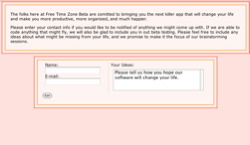
Free Time Zone Beta ist der letzte Ableger von (noch nicht-) Anwendungen, die sich etwas ironisch mit dem Komplex Web 2.0 auseinandersetzen.
(u.a.:
- WEB 2.0 or NOT – demokratische Abschätzung
- Web Two Point Oh! – leere Signifikanten als Geschäftsidee
- Tape it off the Internet – Namedropping, das sich vielleicht realisiert
- Web 2.0 Validator – Analyse der Buzztopics )
Bei Free Time Zone Beta ist nicht uninteressant, dass sie fast überhaupt keine Versatzstücke mehr brauchen, um mit dem Thema zu spielen – eigentlich nur das (ev. zu dick aufgetragene) Beta und das Konzept Einladung, der Rest ist ein Potential. (Dabei ist egal, ob sie es als Witz meinen, oder nicht.)
Bubble Map
Und noch eine Web 2.0 Bubble Map, gut geeignet zum Ausdrucken auf einer Indexkarte.
Warum sollte man Microsoft trauen
Und Joshua Porter macht sich Gedanken darüber, warum er Microsoft seine Attention Metadata anvertrauen sollte (aber nicht darüber, warum man überhaupt jemandem (zumindest explizit, implizit wird wohl ohnehin schon genug Attention genuckelt) diese Daten anvertrauen sollte).
Joho at IBM
David Weinberger macht sich Notizen bei einer Presseveranstaltung von IBM zum Thema ‘The Future of Social Networks’, besonders seine [Kommentare] sind lesenswert.
Ok, the way Web 2.0 is generally being taken up (not just by IBM) is really starting to annoy me. Blogs started in 1999. That’s 6 years ago. And even without blogs, what drove people to the Web were not institutional sites but the ability to talk. The web 2.0 meme makes sense to companies that ignored our voices for the Web’s first ten years.
China 2.0
Rebecca MacKinnon hat vor ein paar Tagen einen interessanten Eintrag zum Thema Web 2.0 in China gepostet: Chinese Bloggers: ‘Everybody is Somebody’
The Chinese economy functions today (to the extent that it does) thanks largely to personal relationship networks: networks that enable people to get stuff done despite bone-headed regulations, politics, logistical obstacles, and everything else. You are nothing in China – and can accomplish very little – without a good “guanxi” network. Expect Chinese internet users to seize upon Web 2.0 tools as a way to expand and deepen their human relationships, enhancing both personal lives and businesses. Expect Chinese users build new tools that suit their own preferred ways of communication. The Chinese are likely to have a growing impact on the evolution of web applications.
Im MoMB gibt es heute dazu ein China Special.
Web 2.0
zu beschreiben ohne ohne Web 2.0 als Term zu verwenden ist Marc Canter zwar nicht ganz gelungen (3 mal kommt es im Text vor), aber den Artikel sollte man lesen.
Die Topics:
Identity
Attention
Open Media
Microcontent Publishing
Open Social Networks
Tags
Pinging
Routing
Open Communications
Device Management and Control
Eine Reise ins Innere von Yahoo
ist der Titel eines Artikels in der N.Y. Times, und das ist es dann zwar nicht, aber doch nicht uninteressant was die soziale Komponente von Yahoo ausmacht.
When millions of people place their comments on a billion-plus photos, surprising patterns emerge: what is interesting, what is offensive, what information people want to share about themselves.
Selbstbeobachtung
Die Wikipedia zum Thema Warum die Wikipedia nicht so toll ist
Web 2.0 Monday
am 7. November in Köln – das Wiki
Warum / Why
Web Montag – bringt Anwender, Entwickler, Gründer, Forscher, Pioniere, Designer und sonstige Interessenten zum Thema Web 2.0 (im weiteren Sinne) zusammen.
Themen / Topics
Technologie: Ajax, API, Atom, Collaboration, E-Democray, E-Learning, Emerging Technology, Feeds, FOAF, Folksonomy, Identity, Instant Messaging, Location-based Services, Long Tail, Microformats, Mobile, Multimodal Interactive (Wireless Voice), Open Source, Podcasting, Privacy, RFID, RSS, Search, Security, Semantisches Web, Social Bookmarking, Social Networks, Social Software, Spam, Syndication, Tags, Tagging, Voice over IP (VoIP), Web 2.0, Weblogs, Web Services, Wikis, Wireless, XFN …
Business: Marketing, Perspektiven Deutschland (NRW, Südwest), Startups, transatlantischer Austausch (Deutschland-USA), Venture Finance …
(file under: keyword 2.0 spam)
(via Oliver Thylmann)
Audiobook
Tom Coates zu BBC’s Annotatable Audio Project und ein Kommentar von Thomas Vanderwal
Facebook By Numbers
- 5M+ registered users
– coverage of 45% of US colleges (a total of 2,000 – representing 8M students)
– 80% penetration among students of colleges that are on the platform
– 10th most visited Internet site in the US
– 5.5B page/views a month (230M page/views a day)
– 8.5M unique visitors
– signing 20,000 new users a day
– repeat usage: daily 70%, weekly 85%, monthly 93% – can you think of another site that sees 93% of its registered users coming back every month ?
live
Mit dem Start von Microsoft Live erwarte ich mir in der näheren Zukunft ob des Namens / der URL dieses Blogs fantastische Zugriffszahlen, muss nur das Keyword Microsoft verstärkt aber natürlich unaufdringlich einfließen lassen.
Es läuft leider mit Firefox oder IE Mac (den ich mir extra deswegen heruntergeladen habe) noch nicht so wirklich, also nur ein Link zu einem Photo von Michael Arrington auf Flickr (das ganze Set ist lustig).
Die Begriffe:
- Digital Lifestyle (TV and Movies, Music, Memories, Education, Games, Productivity, Communication)
- Digital Workstyle (Spotting Trends for business intelligence, Presence, Unified Communication, Improving Personal Productivity, Insights and structured workflow, Team Collaboration, Optimizing supply chains)
- und dazwischen: Maps/Travel Planning, Calendars/Scheduling, Finding Information, Buying/Selling.
Mini-hompy
Ich will ein Mini-hompy
(siehe Hypercortex)
Wikipedia gedruckt
Nicht unwitzige Wendung: die Encyclopaedia Britannica gibt nicht mehr es doch noch (danke Mathias) in Buchform (soweit ich weiss), Teile der Wikipedia könnten aber bald gedruckt werden, um sie auch in weniger vernetzten Ländern zugänglich zu machen.
siehe Reuters/Yahoo News
Web 2.0 Sudoku
Future Study Wiki Raid
Heute ist übrigens der Future Study Wiki Raid
We would like to organize a global, 24-hour effort to add as much information regarding futures studies as we possibly can – and in as many languages as we can – to the Wikipedia on-line encyclopedia. We are asking for individuals to volunteer to describe or explain some specific aspect or sub-topic in futures studies, and then input that (or find an input buddy to add it) to Wikipedia.
Was die Geschäftswelt von Open Source lernen kann
Amüsante Keynote von Paul Graham bei der OSCON 2005 (gibt es auch als Text hier).
(note to self: bzgl. der Selbstausbeutung überdenken)
ein paar zitate:
I think the most important of the new principles business has to learn is that people work a lot harder on stuff they like.
It was the narrowness of such channels that made professionals seem so superior to amateurs. There were only a few jobs as professional journalists, for example, so competition ensured the average journalist was fairly good. Whereas anyone can express opinions about current events in a bar. And so the average person expressing his opinions in a bar sounds like an idiot compared to a journalist writing about the subject.
On the Web, the barrier for publishing your ideas is even lower. You don’t have to buy a drink, and they even let kids in. Millions of people are publishing online, and the average level of what they’re writing, as you might expect, is not very good. This has led some in the media to conclude that blogs don’t present much of a threat— that blogs are just a fad.
Those in the print media who dismiss the writing online because of its low average quality are missing an important point: no one reads the average blog. In the old world of channels, it meant something to talk about average quality, because that’s what you were getting whether you liked it or not. But now you can read any writer you want. So the average quality of writing online isn’t what the print media are competing against. They’re competing against the best writing online.
And when I read, say, New York Times stories, I never reach them through the Times front page. Most I find through aggregators like Google News or Slashdot or Delicious. Aggregators show how much better you can do than the channel. The New York Times front page is a list of articles written by people who work for the New York Times. Delicious is a list of articles that are interesting.
The third big lesson we can learn from open source and blogging is that ideas can bubble up from the bottom, instead of flowing down from the top. Open source and blogging both work bottom-up: people make what they want, and the best stuff prevails.
Does this sound familiar? It’s the principle of a market economy. Ironically, though open source and blogs are done for free, those worlds resemble market economies, while most companies, for all their talk about the value of free markets, are run internally like communist states.
There are two forces that together steer design: ideas about what to do next, and the enforcement of quality. In the channel era, both flowed down from the top. For example, newspaper editors assigned stories to reporters, then edited what they wrote.
Open source and blogging show us things don’t have to work that way. Ideas and even the enforcement of quality can flow bottom-up. And in both cases the results are not merely acceptable, but better.
Der Triumph der Amoralität
Wolfgang Sommergut zu/gegen Nicholas Carr’s The amorality of Web 2.0
Mein Senf: Carr hat mit der Amoralität des Web 2.0 (auf eine von ihm nicht so gemeinte Weise) nicht so unrecht, weil sich die Geschäftsmodelle des Publizierens verschieben bzw. schon verschoben haben (siehe AdSense, Ebay, Amazon, AOL/Weblogs Inc., usw.), also weg von bezahlten, redaktionell erstellten Inhalten, hin zu dem grauenhaften Terminus ‘user generated content’ und den Vermarktungsstrukturen und Verwertungsinteressen, die sich darum gruppieren.
Verdichtet
So konzentriert hab ich den Web 2.0 Diskurs auch noch nicht gesehen: Thomas Burg’s Reloaded.